Appearance versus reality
Don QuixoteIn Don Quixote, appearance versus reality is not merely a contrast between mistaken perception and correct information. It is a recurring contest between what Don Quixote believes the world signifies and what the narrative reveals it to be. A funeral procession becomes a threat from another world, a frightening night noise comes from machinery, and a barber’s basin becomes Mambrino’s Helmet. The episodes repeatedly let the reader see both interpretations at once: the ordinary circumstances are disclosed, yet Don Quixote continues to act according to the chivalric meaning he has imposed on them.
Misreading as a Chivalric Habit
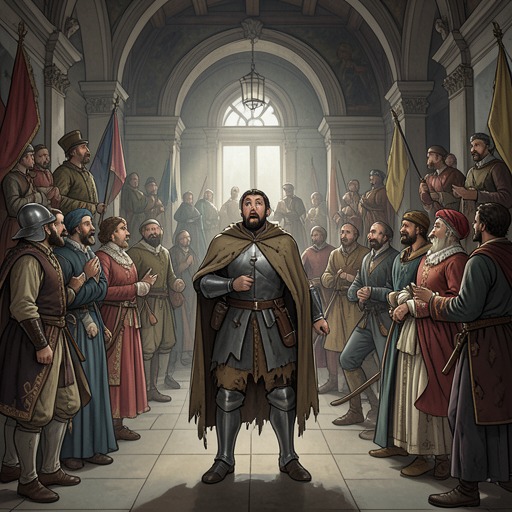
Don Quixote approaches uncertain sights and sounds through the expectations of knight-errantry. When the men accompanying a dead body cannot stop to answer his questions, he takes their response as cause to challenge them. His effort to seize a mule’s bridle precipitates confusion, and he charges the procession. The men, who are dressed in mourning and carrying torches, flee; those less able to move are left behind. The narrator presents the encounter as a mistaken reading of an actual funeral company, not as a supernatural danger. Yet within Don Quixote’s understanding, the scene has the force of a hostile adventure, and Sancho Panza watches his master’s courage with astonishment.
The aftermath makes the divide explicit. A bachelor from the procession explains that the party was travelling at night in mourning clothes, carrying lights and praying, and therefore had looked to Don Quixote like beings from another world. Don Quixote accepts that these circumstances explain his attack, but he does not treat them as proof that his perception was wrong: he maintains that he would have performed his duty even if the procession had truly consisted of devils. The correction establishes the mundane cause of the error without undoing the knightly logic that produced it. His declared mission to redress wrongs is thus set against the consequences of acting on appearances before understanding them.
The Noise of the Fulling Hammers
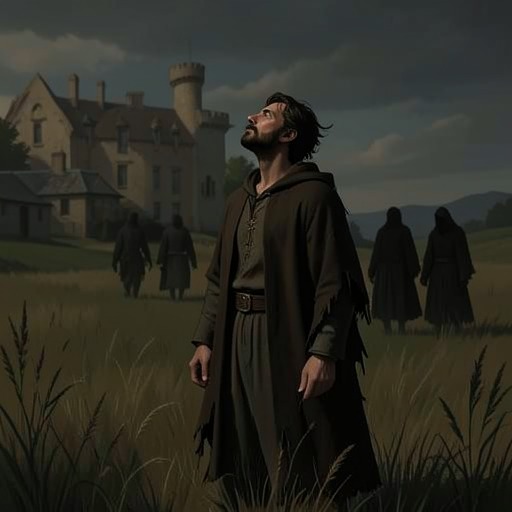
A second episode turns the same conflict into a shared experience between master and squire. Through the night, the sound of water and repeated blows fills Don Quixote and Sancho with fear and uncertainty. They proceed toward the noise among chestnut trees and reach a meadow beneath high rocks, where water rushes down toward roughly built houses. Rocinante is frightened by the sound; Don Quixote advances cautiously, commending himself to his lady and to God, while Sancho follows beside him.
The source proves to be six fulling hammers striking in alternation. The discovery abruptly changes the scene’s meaning: what had sustained suspense as a possible perilous adventure is machinery. Don Quixote stands with his head lowered in mortification; Sancho can barely contain his laughter. He repeats his master’s earlier boasts about being born to revive the Golden Age, turning the knight’s grand self-presentation into the joke. Don Quixote, angered by the mockery, strikes Sancho and argues that he could not have been expected to recognize a machine he had never seen. He insists that had the hammers been giants, he would have faced them. The exchange shows both men registering the same evidence but assigning it different value: Sancho treats the noise as a practical mistake and a good story, while Don Quixote preserves the possibility of heroism by shifting attention to what he would have done under different circumstances.
The episode also remains between them after the laughter and quarrel. Don Quixote warns Sancho not to mention the fulling mills again, and Sancho falls silent for fear of provoking him. Their disagreement therefore does more than expose a false alarm. It shows the personal cost of pointing out the difference between the knight’s interpretation and the facts, while the later return of the incident in their conversation confirms how readily an embarrassing misreading can become shared material for ridicule.
The Barber’s Basin and Enchantment
The barber’s basin offers the clearest account of how an ordinary object is transformed by Don Quixote’s imagination. The narration explains that a barber from a larger village was travelling to a smaller neighboring one to attend to a sick man and another man who needed shaving. He carried a brass basin; when rain began, he put it on his head to protect his hat. From a distance, the bright basin could be mistaken for a helmet. He rode a gray ass, which Don Quixote perceived as a dapple-gray steed, and the rider as a knight. Don Quixote charged him without first finding out who he was or what he carried.
After the barber leaves the basin behind, Sancho recognizes it as a useful, damaged household object and calculates its value in ordinary terms. Don Quixote instead turns it in his hands, tries it on, and concludes that it must be a famous helmet made for an unusually large head, though incomplete. Sancho laughs but checks himself, mindful of his master’s anger. The contrast is not just between two names for the same thing: each name belongs to a different practical world. For Sancho, the basin can be repaired and used for shaving; for Don Quixote, it is a trophy of chivalric history.
When Sancho later objects that the object is plainly a barber’s basin, Don Quixote supplies a theory that protects his interpretation: enchanters alter how things appear, making a helmet seem like a basin to other people. He treats the disagreement itself as evidence of interference, reasoning that enchantment keeps the prized helmet safe from those who might otherwise take it. Sancho, by contrast, says he has the dented basin in his sack and intends to have it mended for use at home. The material object persists through their dispute, but its meaning remains divided between their accounts.
Comedy, Consequence, and the Reader’s View
These episodes make the reader an observer of two levels of reality at once. The narrative supplies concrete explanations—the mourners’ clothing and torches, six hammers, a barber’s errand, a brass basin, a gray ass, and rain—while showing how Don Quixote converts those details into the signs of adventure. Because the reader is given the explanation that Don Quixote rejects, the resulting comedy depends on dramatic irony: his certainty is visible alongside the evidence that unsettles it.
The consequences are not always harmless. In the procession episode, his confidence in a false interpretation brings the travellers into conflict and leaves the bachelor complaining that Don Quixote’s attempt to redress wrongs has instead injured him. In the fulling-mill episode, the mistaken fear gives way to laughter, followed by anger between master and squire. In the basin episode, the disagreement persists as a dispute over what the object is and what it is worth. Across these scenes, Sancho repeatedly supplies a practical counter-reading, but his awareness does not simply dissolve his attachment to his master or end their shared adventures.
The pattern also clarifies the resilience of Don Quixote’s imagined world. Evidence can reveal what a thing is, and Sancho can name it plainly, but Don Quixote can answer contradiction by invoking enchantment or by insisting that the real test would have come in a different encounter. Appearance and reality therefore remain more than a sequence of errors: their conflict drives action, produces comic reversals, and exposes the strain between a heroic ideal and the ordinary circumstances on which it is imposed.